战场开场Battlefield Opening
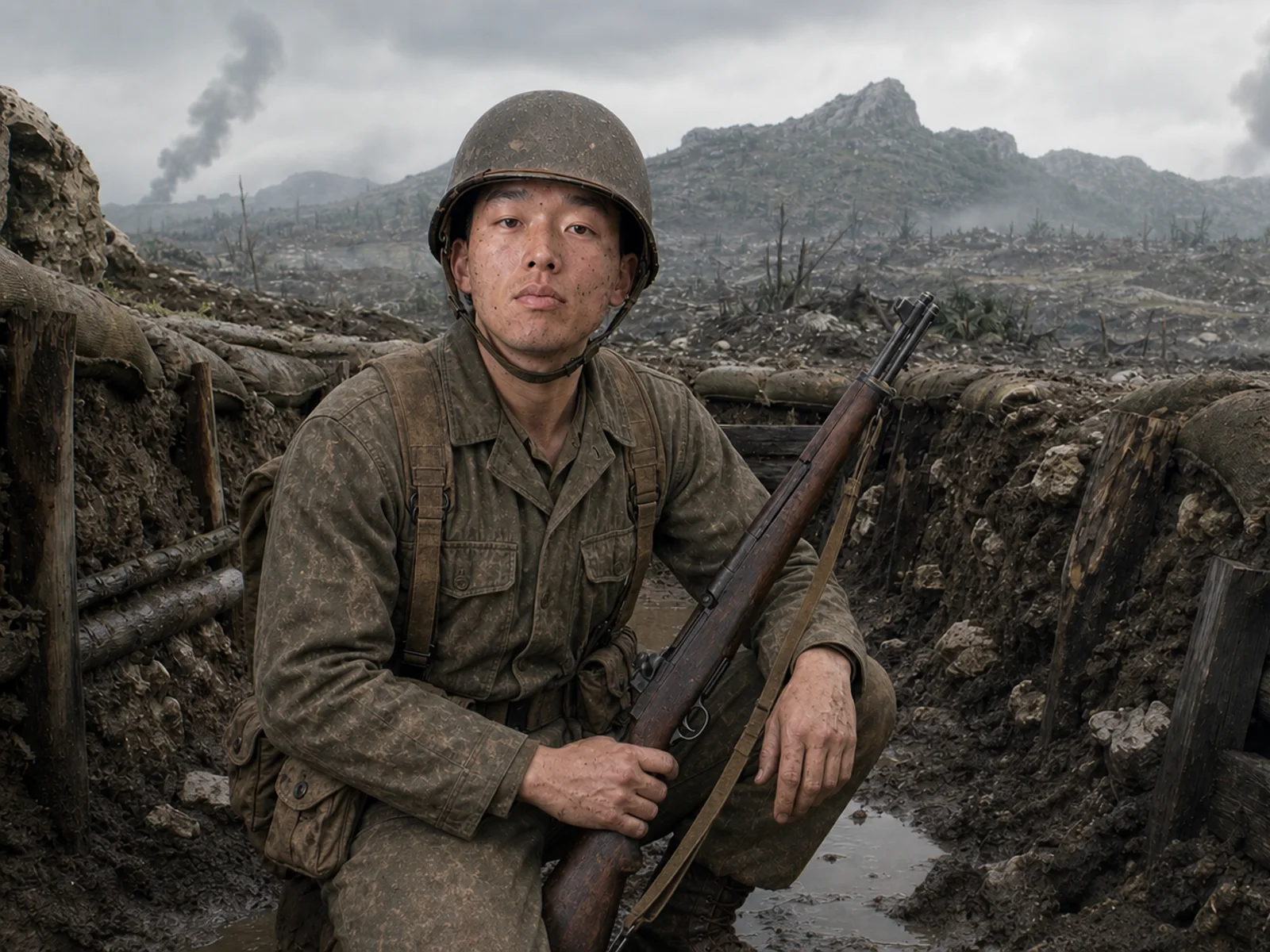
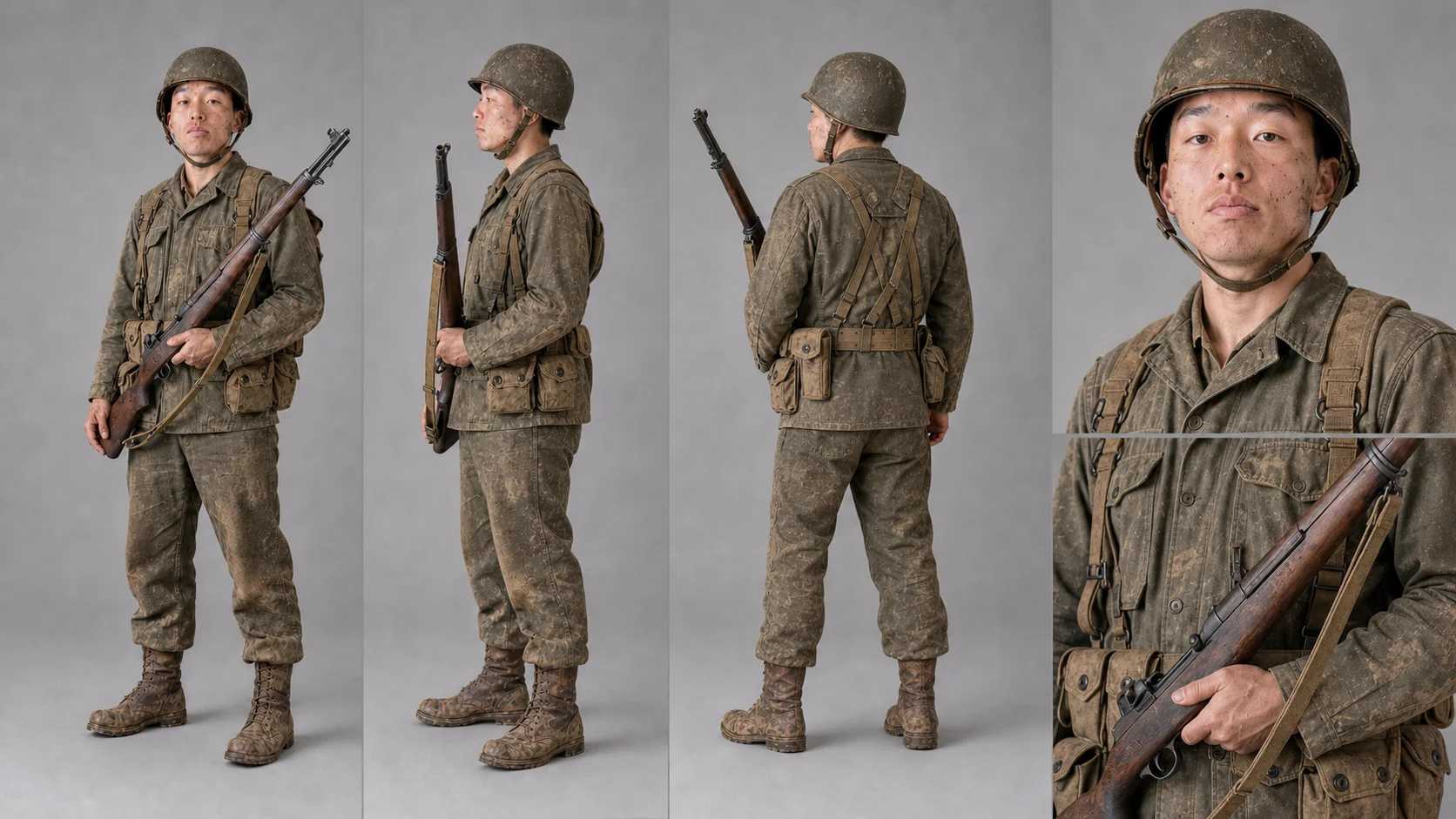
《面向西藏青年》AI 知识系列最后一期,片头要一段战场。让 AI 出一张好图很容易;让第二镜和第一镜是同一片战场、同一个人、同一支枪,才是这类片子的工作量。所以这个项目的主体是一条受控的资产链:一张脸推出角色母版,母版推出多角度参考板,参考板和三张共享地理的环境图合成关键帧,关键帧才是每一镜的第一帧。二十五张图逐张过审,两张被否,一百五十二条判定全部记录在案。开场两镜十七秒已经成片,结尾三镜的提示词定稿了,还没生成。The last episode of an AI explainer series for young Tibetans opens on a battlefield. Getting one good still out of a model is easy. Getting the second shot to be the same battlefield, the same man and the same rifle is where the work is. So the spine of this project is a controlled asset chain: one face produces a character master, the master produces multi-angle reference sheets, and those sheets plus three environments that share a geography compose the key frames that open each shot. Twenty-five stills went through review, two were rejected, and a hundred and fifty-two judgements are on record. The two opening shots are cut. The three closing shots are written but not generated.
- 角色 / Role
- 导演 + 资产与提示词 / Direction, assets, prompts
- 用途 / For
- AI 知识系列片头 / Opening for a series
- 交付 / Delivered
- 开场 2 镜,17 秒 / Two shots, 17 s
- 资产 / Assets
- 25 张受控图 / 25 controlled stills
- 状态 / Status
- 结尾 3 镜未生成 / Ending shots not generated
三张环境图是同一片战场Three environments, one battlefield
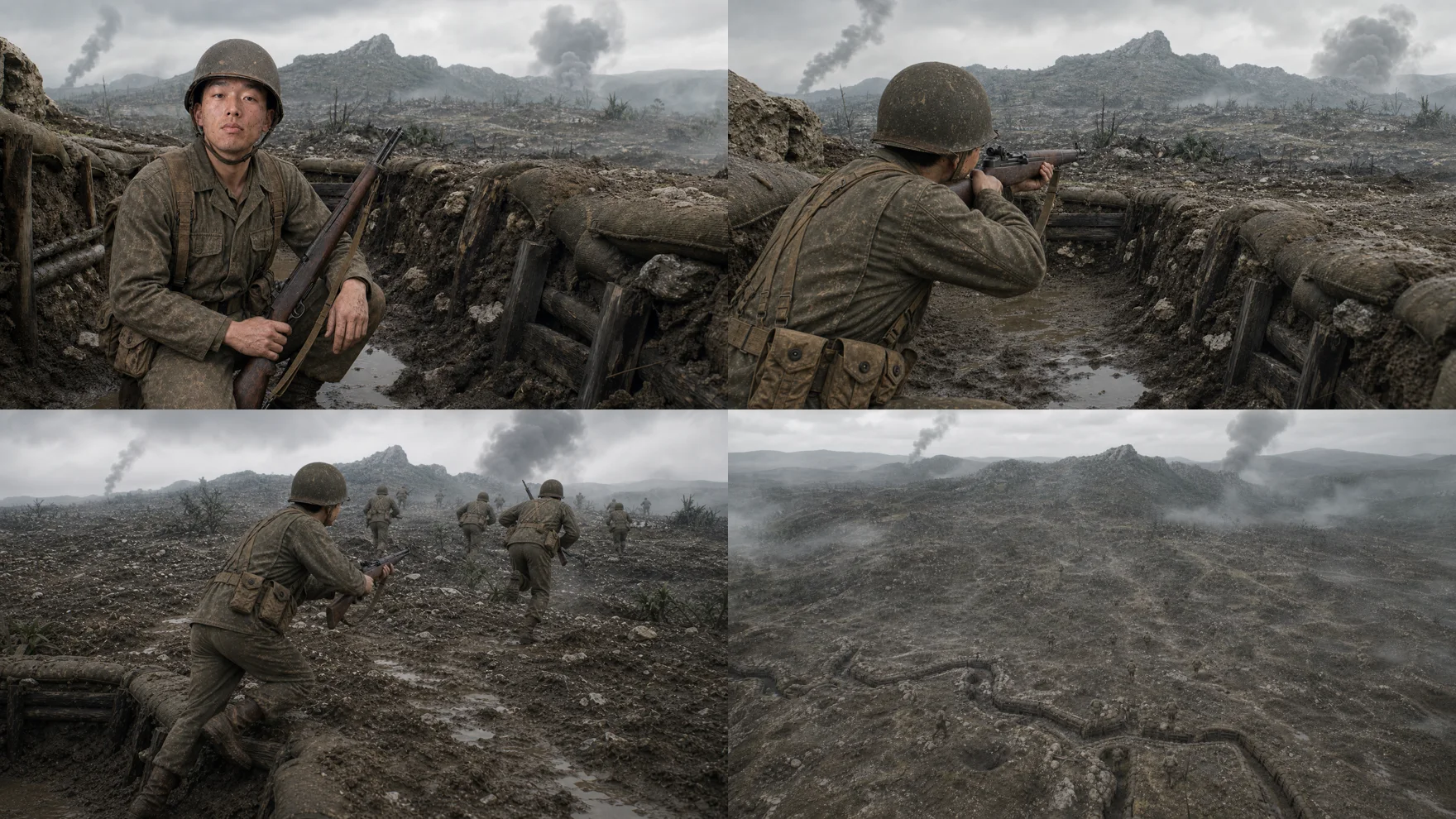
战壕视角、开阔坡地、高空俯瞰,这三张是同一片地形的三个机位。中央那道不对称的尖顶山脊、左侧那道细烟柱、右中那道更宽的烟柱,三张里逐一对得上,后两张都从第一张推出来。观众认地形,不认提示词。所有关键帧只在这三张里合成,没有第四片战场。A trench view, an open slope, a high overhead. Three camera positions on one piece of ground. The asymmetric peaked ridge in the centre, the thin smoke column on the left, the wider one right of centre: all three line up across the images, and the second and third were derived from the first. An audience recognises terrain, not prompts. Every key frame is composed inside those three. There is no fourth battlefield.
一张图被否,评分表上只有一项没过A still gets rejected on one line of the checklist
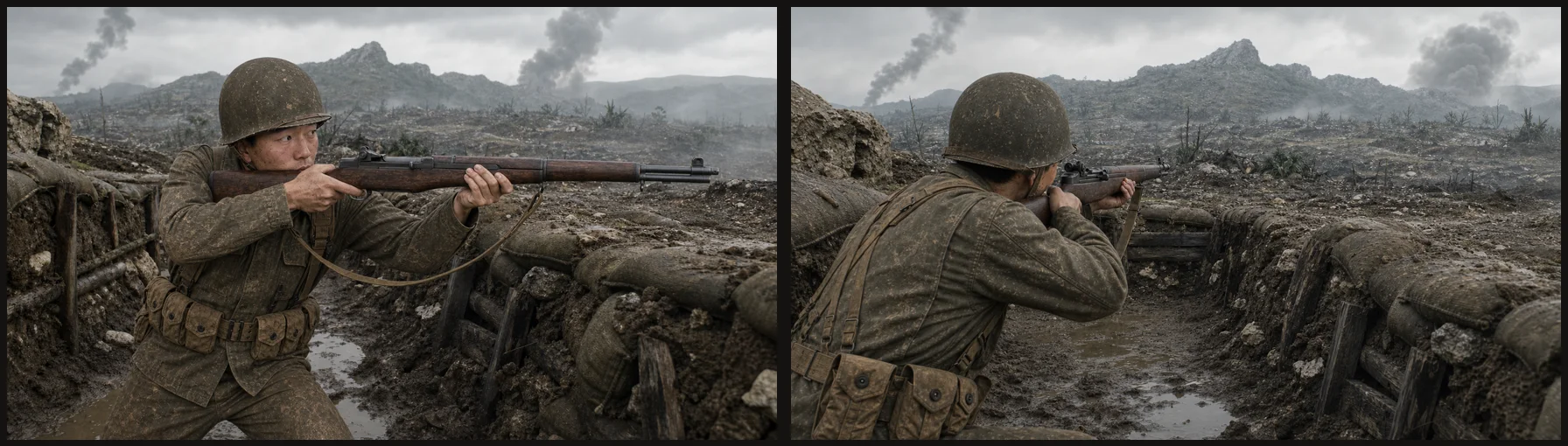
开火镜头的第一版,逐项检查几乎全过:脸认得出、军服装备和参考板一致、两只手结构正确、M1 加兰德的枪托机匣枪管连贯、战壕和山脊也接得上。没过的是枪口朝向。它几乎水平指向画面右侧,而下一镜的冲锋方向是朝中央山脊上坡。从这个姿势接下去,人得凭空转九十度。画得好和接得上是两件事,只有把整段当序列看的人会在这里停下来。The first version of the firing shot passed almost every line: the face reads, the uniform and kit match the reference sheet, both hands are structurally right, the M1 Garand's stock, receiver and barrel are continuous, and the trench and ridge line up. One line failed. The muzzle points nearly level to the right of frame, while the next shot charges uphill towards the centre ridge. Cut from that pose and the man has to turn ninety degrees out of nowhere. Drawing well and cutting together are two different things, and only someone reading the whole sequence stops here.
Spatial action axis: FAIL - the rifle aims almost horizontally toward
screen-right while the approved E02/E03 advance lanes lead from the trench
uphill toward the central ridge. Continuing from this pose into K05 would
require an unmotivated near-90-degree pivot and break the firing-to-charge
geography.

Decision: rejected. Preserve the candidate for audit and regenerate K04
from a rear three-quarter trench camera.提示词里写的是相机行为The prompt describes the camera
「电影感」这三个字在提示词里没有意义,模型不知道你指的是哪一部。所以这套提示词锁死的都是可执行的东西:ALEXA 65 大画幅质感、Sphero 65 50mm 镜头、约 33mm 全画幅视角、24fps、180 度快门、T4 中等景深,以及战壕内克制的肩扛,只允许轻微呼吸和少量稳定调整,禁止推拉、旋转、变焦、倾斜和过度抖动。项目规则里有一条写得很直接:不要拿一个电影名当风格指令,把目标翻译成材质、光、色、镜头和运动。Cinematic means nothing in a prompt; the model does not know which film you mean. So what this prompt set pins down is executable: ALEXA 65 large-format rendering, a Sphero 65 50mm lens, roughly a 33mm full-frame field of view, 24fps, a 180-degree shutter, T4 for medium depth, and a restrained handheld inside the trench, with slight breathing and small stabilising corrections only: no push, no roll, no zoom, no tilt, no heavy shake. One project rule says it flatly: do not use a film title as a style instruction; translate the target into material, light, colour, lens and movement.
Do not depend only on a copyrighted film title as a style instruction;
translate the target into concrete material, lighting, color, lens, and
movement characteristics.

Opening camera: ALEXA 65 look, Sphero 65 50mm, ~33mm full-frame FOV
Motion standard: 24fps, 180-degree shutter, T4 medium depth of field泥必须真的糊在镜头上The mud has to actually hit the glass
第二镜开头一发近失弹把泥推到镜头上,画面糊住一秒多。最省事的做法是加一个数字遮罩或者黑场,所以提示词里把这条路堵死了:遮挡必须是真实附着在镜头玻璃上的泥土,不能是遮罩、淡出、黑场、碎屏或滤镜。泥滑落之后还得留下 5% 到 15% 的半透明泥点和湿痕,主要分布在边缘,一直留到最后一帧。观众信不信这是一台真的在战场里的摄影机,取决于爆炸之后镜头有没有变干净。A near miss at the head of the second shot throws mud onto the lens and the frame is smeared for a little over a second. The easy way to get that is a digital mask or a cut to black, so the prompt closes that road: the occlusion has to be real mud on real glass, not a mask, a fade, a black frame, a shatter or a filter. After it slides off, five to fifteen percent of translucent spatter and wet streaking stays, mostly at the edges, and stays to the last frame. Whether an audience believes there is a real camera in that trench comes down to whether the lens is clean again after the explosion.
0.0-0.3  第一帧精确匹配参考图 1,镜头右后方发生近距离炮弹爆炸
0.3-1.2  湿泥与尘土被爆压真实推向摄影机,撞击并完全覆盖镜头
1.2-2.4  大块泥土在重力作用下滑落,摄影机短促震动一次后稳定
2.4-3.0  镜头玻璃保留 5%-15% 半透明泥点和湿痕,主要分布在边缘
3.0-9.4  主角说完整一句,声音在战场里自然提高,不降低战场密度